Degrees that can't be faked. Verified in seconds.
Credent helps Indian colleges and universities issue tamper-proof digital certificates — degrees, marksheets, transcripts and more — that anyone can verify instantly with a QR code. No more 30–40 day background checks. No more forged certificates.
The old way is slow, and easy to fake
Paper certificates get lost, forged, and take weeks to check. That costs institutions their reputation and costs students opportunities.
The time an employer typically spends verifying a degree by phone and post.
Most institutions still keep academic records on paper or in disconnected systems.
Forged and tampered certificates are a real and growing problem worldwide.
From exam results to instant verification
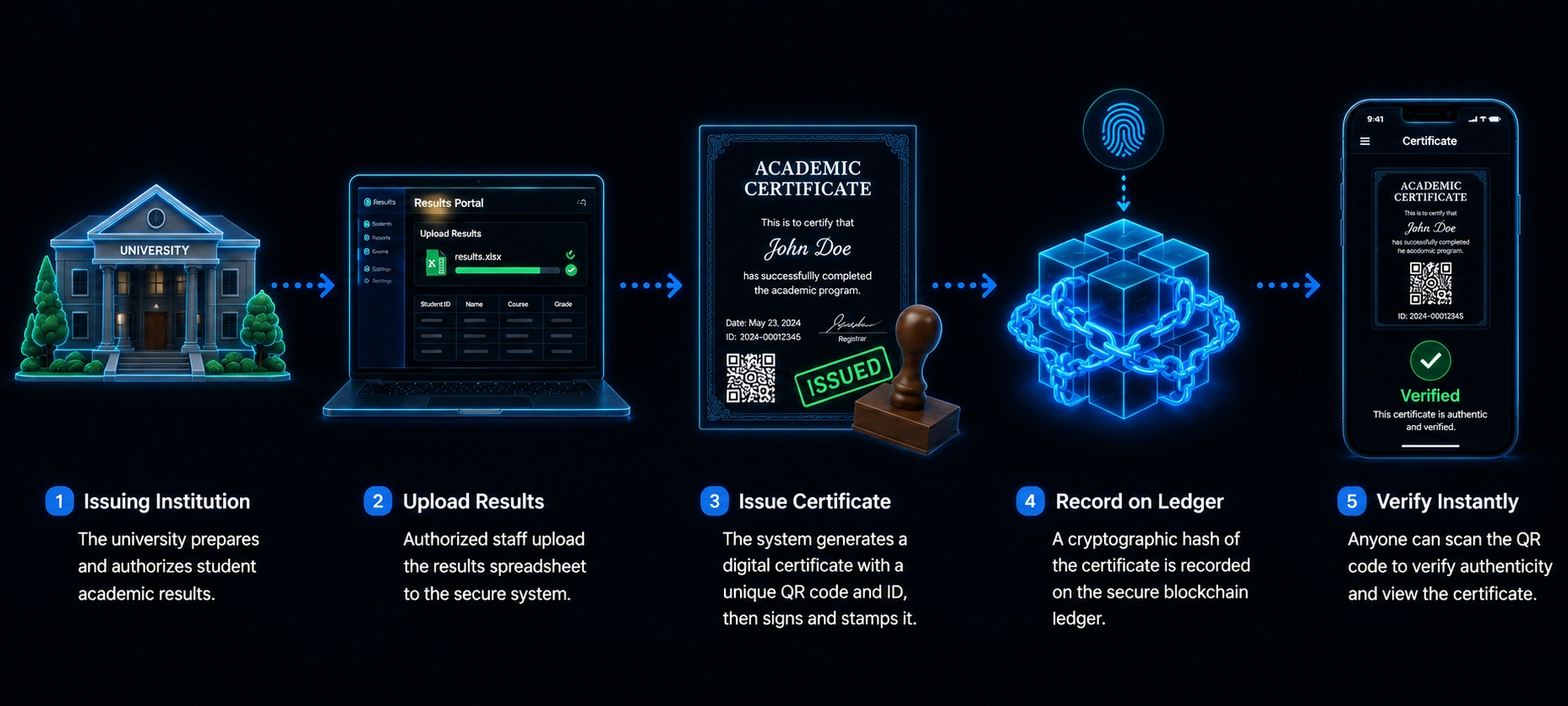
Here is the full journey of one certificate — from the college declaring results to an employer confirming it in seconds.
Onboard your institution
Set up your college once. Staff get clear roles — a clerk can prepare results, but only an authorised officer can approve issuing. Everyone signs in securely.
Upload results (Excel / CSV)
Upload thousands of students at once. Credent checks every row and hands back a clear, line-by-line report — duplicate roll numbers, missing marks, and so on. Nothing is ever silently dropped.
Design the certificate once
Choose your layout, logo and seal. Every certificate then comes out pixel-perfect and identical, every time, with a built-in QR code.
A named officer approves
Before anything goes out, an authorised officer reviews and approves the batch. The person who prepared it cannot approve it alone — full accountability.
Issue & anchor on the blockchain
Certificates are generated as PDFs, and a tamper-proof fingerprint of the batch is anchored on a public blockchain. Only the anonymous fingerprint is stored on-chain — never a name, mark, or any personal detail.
Deliver to students
Students claim their credentials with just a phone number and a one-time code, then view, download and share them. No wallet, no keys, no crypto — ever.
Verify in seconds
Anyone scans the QR code or opens the link and instantly sees Valid / Revoked / Superseded — checked against the blockchain, free, with no account needed.
Correct & revoke anytime
Withdraw a wrong certificate or issue a corrected one; verifiers always see the current truth. Every action is written to a permanent, tamper-evident log.
Four simple ideas do all the work
You don't need to understand blockchain to trust the result. Here's the whole trust model in plain English.
The fingerprint
Every certificate has a unique digital fingerprint. Change one letter or one mark and the fingerprint changes completely — so tampering is instantly detectable.
The institution's signature
Each certificate is digitally signed by the college and checkable against its official web address. A fake won't carry a valid signature.
A public, unchangeable ledger
Fingerprints live on a public record nobody — not even us — can secretly change or delete. Even if Credent disappeared, credentials would still verify.
No single point of forgery
Issuing a real certificate needs two independent keys — the college's and the platform's — kept in separate vaults. No lone insider can forge a degree.
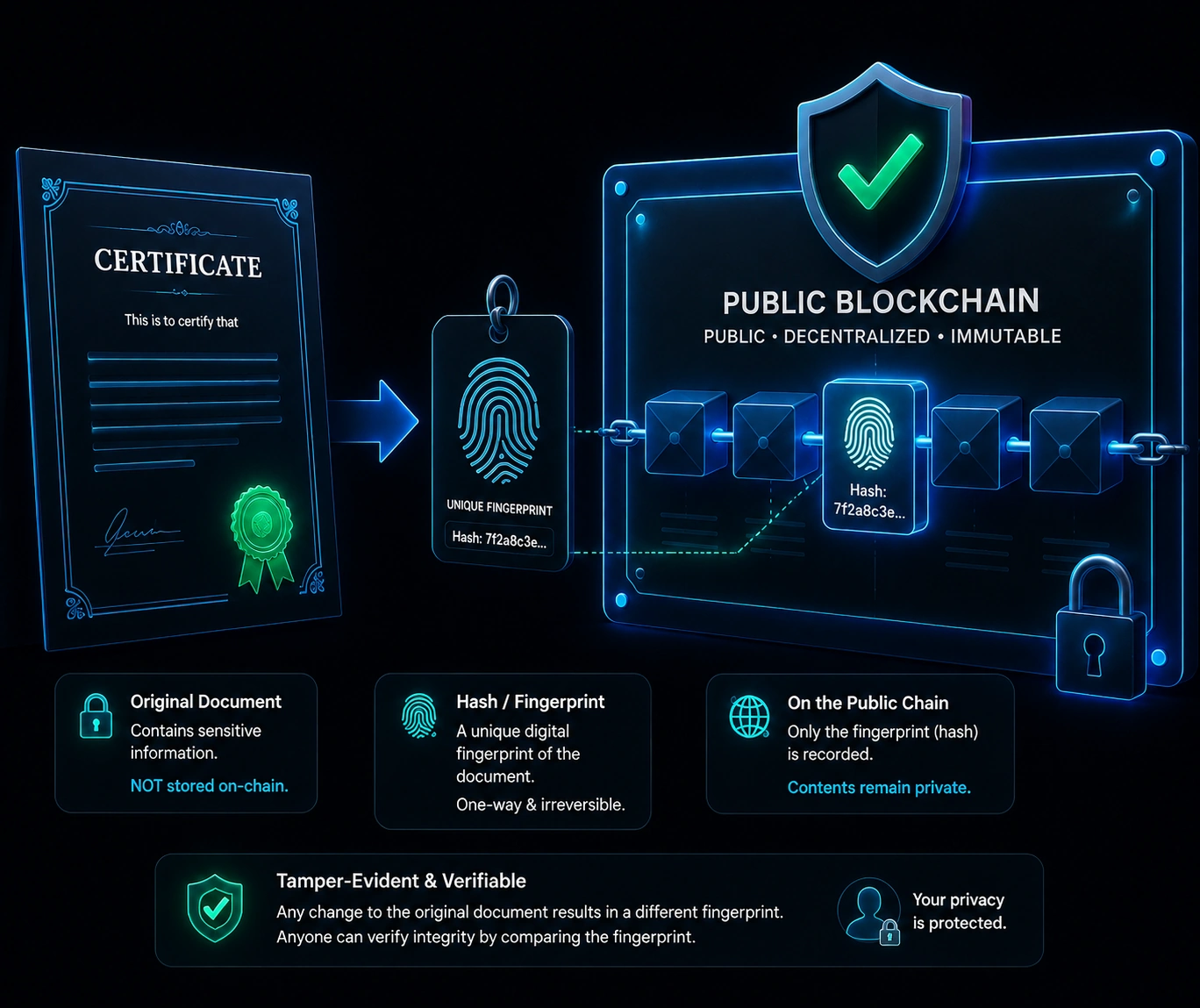
Honest note The blockchain gives tamper-evidence and independence — not magic. It means trust doesn't rely on simply taking our word for it.
One system, three happy sides
Institutions
- Issue whole batches in hours, not weeks
- Cut certificate fraud and admin load
- Approval controls & full audit trail
- Ready for NAD / ABC / DigiLocker
Students
- Get your degree online, claim by phone
- View, download & share instantly
- Works on any Android, even weak internet
- No wallets, keys or crypto to manage
Employers & universities
- Verify any certificate in seconds
- Free, no account, just scan the QR
- Independently checkable on the ledger
- See revoked / corrected status clearly
Everything an institution needs
Roles & approvals
Fine-grained permissions with a mandatory, named approval step before any issuance.
Bulk upload
Excel/CSV import with smart validation and a clear, row-by-row error report.
Certificate designer
Design once; every certificate renders pixel-perfect and identical, forever, with a QR.
Blockchain anchoring
A tamper-proof fingerprint of every batch on a public, unchangeable ledger.
Student wallet
Phone-first claim, view, download and share. No crypto knowledge required.
Instant verification
Public QR/link verification with a clear Valid / Revoked / Superseded verdict.
Revoke & reissue
Cancel or correct certificates; verifiers always see the current truth.
Tamper-evident audit log
A permanent, verifiable record of who did what — built for compliance.
Privacy by design
No personal data on-chain; data stays in India; erasure honoured on request.
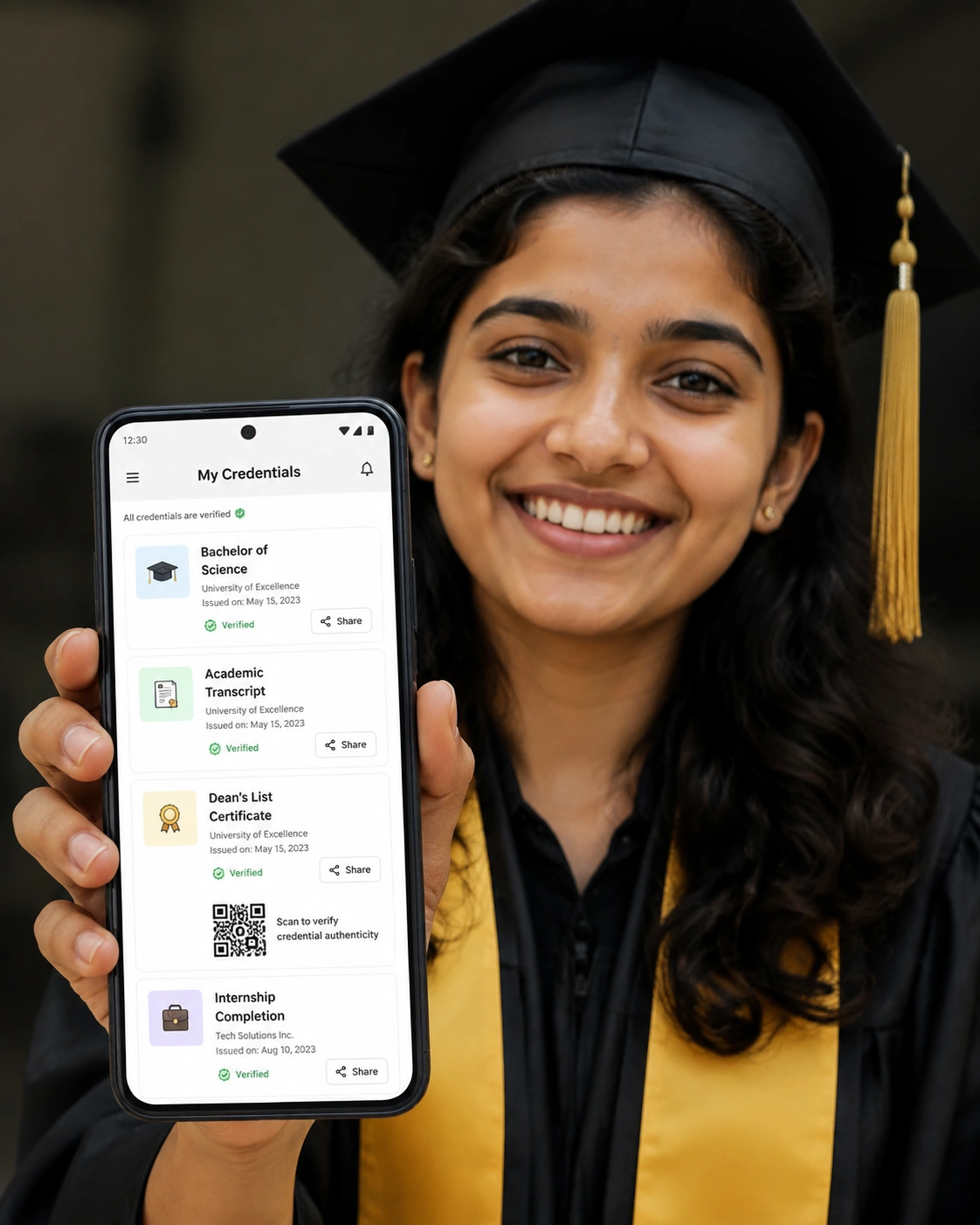
Your credentials, in your pocket
Built for real students on mid-range Android phones and patchy mobile data — not for crypto experts.
- Claim your certificate with just your phone number and a one-time code
- View and download the exact PDF an employer will recognise
- Share as a link or QR — and control who sees it
- Never see a seed phrase, private key, or cryptocurrency
Private by design, and built for Indian law
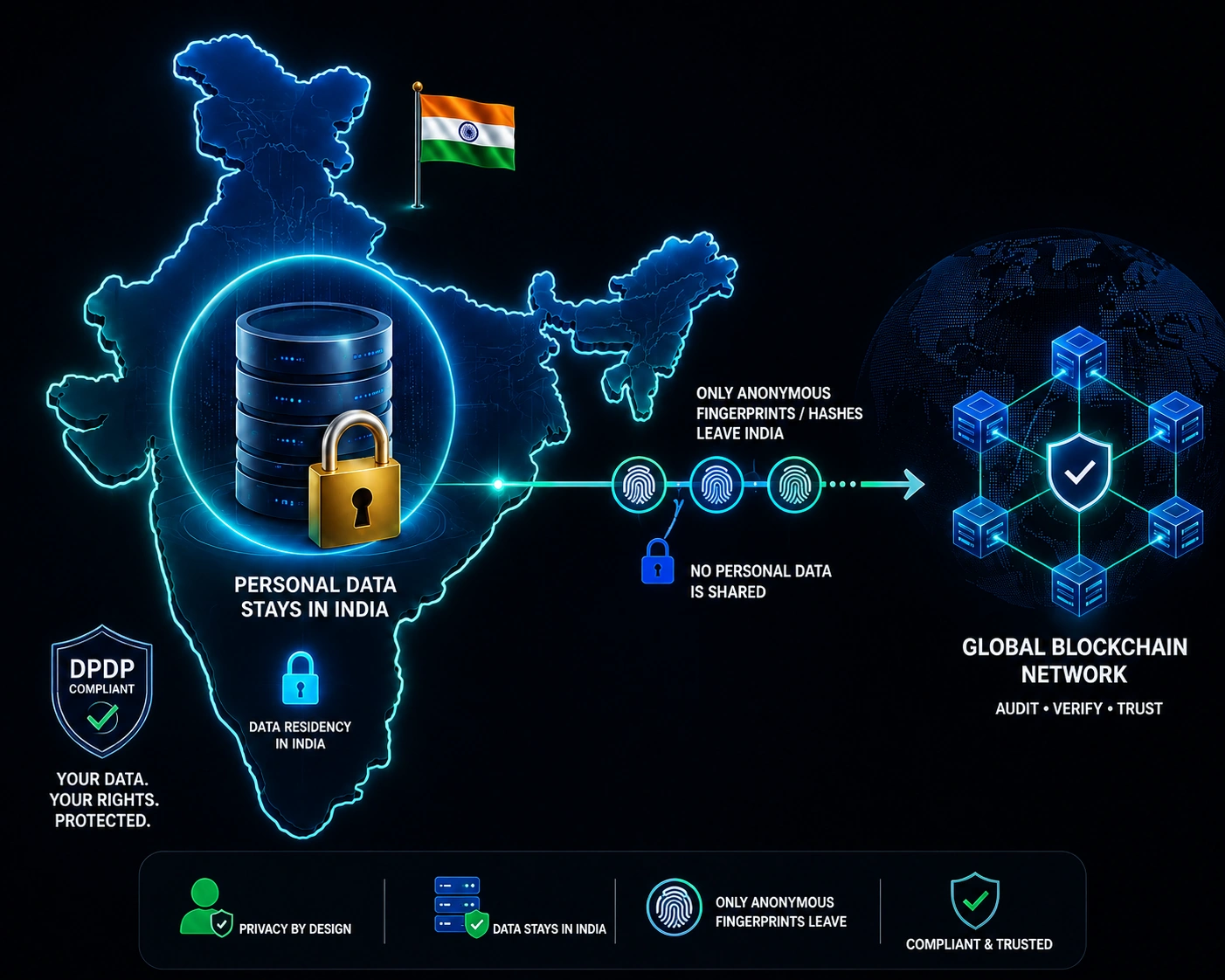
Personal data is protected and kept inside India. Only anonymous fingerprints ever touch the public blockchain.
- No personal data on-chain — names, marks and IDs never leave for the blockchain
- Data stays in India — all learner data and backups in Indian regions
- Right to erasure (DPDP) — we can make a person's data permanently unreadable while the certificate stays verifiable
- Revocation & correction — cancel or supersede certificates with clear, honest status
What an employer sees
One scan, one clear answer — in about three seconds, on any phone.
Questions people actually ask
If no personal data is on the blockchain, how does verification prove the degree belongs to the student?
The student's name is inside the certificate — which they hold and share. The blockchain only holds an anonymous fingerprint of that certificate. When someone verifies, the system takes the certificate they were given, computes its fingerprint, and checks that exact fingerprint against the college's signed records on the ledger. Because the name is part of the document and any change breaks the fingerprint, the name is locked to what's on-chain — without ever being written on-chain. You verify a specific document you're handed; you never search the ledger for a person.
Do students need a crypto wallet or to understand blockchain?
No. Students claim credentials with just a phone number and a one-time code, then view, download and share — like any normal app. No wallets, seed phrases, private keys, or cryptocurrency, ever.
Which blockchain do you use, and what's stored on it?
We anchor on a fast, low-cost public blockchain (Solana) using an open attestation standard. Only anonymous fingerprints and revocation status are stored — never names, marks, or any personal information.
What happens if your company shuts down?
The fingerprints stay on the public blockchain, and each certificate carries the college's own signature. So credentials remain independently verifiable even if Credent were no longer around — that independence is the whole point.
Is it compliant with Indian regulations?
It's built around India's DPDP Act 2023 and data-residency expectations: personal data stays within Indian regions, and erasure is honoured. It's designed to work alongside NAD, ABC and DigiLocker.
Can a certificate be cancelled or corrected?
Yes. An authorised officer can revoke a certificate or issue a corrected one. From then on, anyone verifying sees a clear "Revoked" or "Superseded — view current version" status. A revoked certificate is never shown as valid again.
Bring trusted digital credentials to your institution
Run a pilot with one batch of real credentials and see the whole flow end to end — issue, deliver, verify, revoke.